-
Get a £5 M&S voucher with your currency when you collect in a bureau. Find out how.

What is the currency in Colombia?
The currency in Colombia is the Colombian peso, and it’s worth knowing the basics of this South American country’s currency if you’re planning a trip. Whether you’re shopping for souvenirs in the cobblestone streets of Cartagena or heading out for a meal in the vibrant capital of Bogota, it’s really helpful to know how prices in Colombian pesos compare to pounds in the UK.
We’ve covered everything from COP to GBP exchange rates, average prices and popular payment methods in this Colombia currency guide – so you know what to expect while you’re there. And don’t forget to buy Colombian pesos before you go, so you’ve got the correct cash in your pocket when you arrive.
The Colombian peso: everything you need to know
The Colombian peso has been the official currency of Colombia since 1837 when it replaced the Colombian real. It’s represented by the currency code COP and the symbol $. COP comes as both coins and banknotes.
Colombian peso denominations
Coins include:
$50, $100, $200, $500, $1,000
Banknotes include:
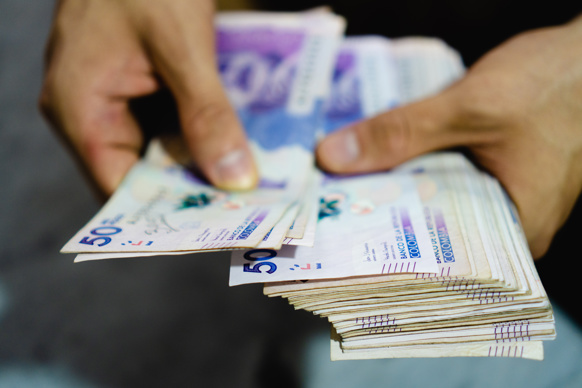
$2,000, $5,000, $10,000, $20,000, $50,000, $100,000
What is the current exchange rate for the Colombian peso?
Exchange rates change all the time, so use our currency calculator to check today’s pound to Colombian peso rate.
What currencies can you use in Colombia?
The Colombian peso is the only currency officially accepted in Colombia, so this is the currency to take with you when you go. You might find that US dollars are also accepted in areas popular with tourists – like Bogota, Medellin and Cartagena – but it’s best not to rely on this. And if you’re paying by card, bear in mind that you may be given the option to pay in Colombian pesos or an alternative currency – like pounds or US dollars. It’s usually best to pay in the local currency when you’re abroad, because of card fees and exchange rates.
What payment methods are accepted in Colombia?
Colombia’s all set up to accept a range of payment methods. These include:
Cash
Cash is the most popular payment method used in Colombia and it’s very widely used here for day-to-day purchases like shopping and restaurant bills. Having some cash to hand will also be particularly useful for things like markets and street food stalls, where card payments are unlikely to be accepted. Bear in mind that when you get home, you can sell currency back at an M&S Travel Money bureau* – so you can take as much cash as you need without worrying that you’ll have lots left over.
Debit and credit cards
Generally, larger businesses in Colombia are well set up to accept debit and credit card payments and you’ll find that Visa and Mastercard are the most widely accepted options. American Express may be less widely accepted, so bear this in mind when you travel and always carry a mixture of payment options including cash for smaller shops and markets.
If you’re withdrawing cash from an ATM in Colombia, you may be given the option to use Dynamic Currency Conversion (DCC) to convert the amount from Colombian pesos into GBP. There’s likely to be a high markup if you do this, so it’s best to decline this offer and choose pesos – we’ve explained more in our guide to paying in pounds vs the local currency.
Digital wallets
Apple Pay and Google Pay are both available in Colombia, and you’ll find digital wallet payments are possible at large shops, restaurants and businesses in big cities like Medellin and Bogota. If you’re going off the beaten track in Colombia, you’re less likely to be able to rely on digital wallet usage and it’s even more important to have several payment options including cash.
How much money should I take with me to Colombia?
When you’re budgeting for your trip, it’s worth checking entrance fees to attractions you’d like to visit before you go as they can vary depending on where you’re staying. The entrance fee to the Castillo de San Felipe in Cartagena, for example, is 25,000 COP for foreigners, whereas the cost to visit the Gold Museum in Bogota is much lower at 5,000 COP.
It’s also worth knowing that the cost of living in Colombia is around 53% lower than the UK at the time of writing, so it’s likely you’ll find things like entertainment and eating out will cost you less than back home. To help you work out how much spending money you might need, we’ve listed some example costs in Colombia vs the UK below* – just keep in mind these prices are illustrative.
A mid-range three-course meal for two: £65.00 in the UK vs £22.57 (Col$115,000.00) in Colombia
A small domestic draught beer: £5.00 in the UK vs £1.18 (Col$6,000.00) in Colombia
A regular cappuccino: £3.56 in the UK vs £1.36 (Col$6,945.93) in Colombia
A one-way ticket on local transport: £2.50 in the UK vs 65p (Col$3,300.00) in Colombia
*Example prices from Numbeo.com correct as at May 2026. All prices are illustrative.
Buying Colombian pesos with Marks & Spencer Travel Money
Packed and ready to go? Don’t forget to take some local currency in cash to use alongside card payments. You can buy Colombian pesos online to collect for free from 580+ participating M&S stores*.
*T&Cs apply. Subject to availability. Sell-back only available at bureau locations.
Share with your friends


