-
You can now use Apple Pay and Google Pay online and in store.

When is the best time to see the Northern Lights in Iceland?
If you’re planning a trip to Iceland and hoping to see the Northern Lights, the best time to go is usually between September and April – and particularly the months of October and March. This is when factors like solar activity and cloud cover give you the best possible chance of glimpsing the Aurora Borealis, to use their official name, although there’s never any guarantee they’ll make an appearance.
The Northern Lights can be seen when the sun releases charged particles – known as a Coronal Mass Ejection – which hit gases in the Earth's atmosphere. They’re particularly visible in high-latitude areas like the Arctic, although with the right conditions they can be seen from around the world.
2026 is a particularly good time to see them, as the sun is still at the height of its 11-year solar maximum – when solar activity peaks and sightings are stronger and more frequent. From 2027 onwards, it will gradually decrease as the cycle heads toward its minimum, so your chances of seeing the aurora in Iceland will be slimmer.
We’ve gone into more detail about the best time to see the Northern Lights in Iceland in this guide, including things like the best time of day and where to view them from. When you’ve booked your trip, don’t forget to buy your Icelandic krona so you’ve got some cash to take with you on your travels.
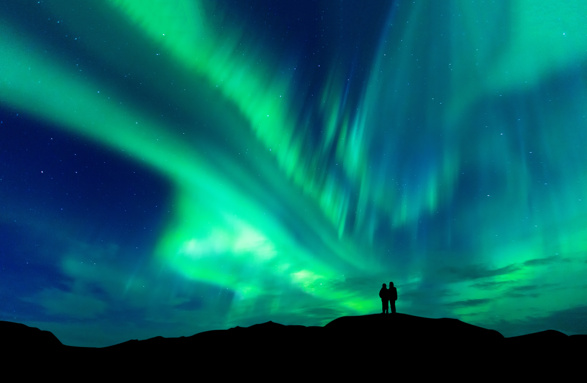
Best months to see the Northern Lights in Iceland
Iceland’s winter months offer optimal conditions to see the Northern Lights, and the period from early September to April is considered the best time to go. This is when night skies are dark and long enough to view the aurora, and solar activity is high, although you’ll need to keep a close eye on the weather forecast as conditions vary from one day to the next.
October is considered a particularly good time to go – it’s Autumn in Iceland, so temperatures haven’t yet dropped too low to spend nights out searching for the Northern Lights, and the roads aren’t yet thick with snow – making it easy to drive to peak viewing spots. Solar activity is high due to the autumn equinox this month, and the skies are particularly dark without the snow of midwinter reflecting light back into the sky.
March is another good time to visit Iceland, especially if you want to combine a trip to see the Northern Lights with other activities. Iceland is still generally very cold and covered in snow in March, so snowmobiling and skiing are popular daytime activities. Plus, the days are a little longer than October – with up to 13 hours of daylight towards the end of the month – meaning more time to do things in the daylight, but still plenty of opportunities to search for the Northern Lights at night. The spring equinox also happens this month, bringing vivid aurora along with it.
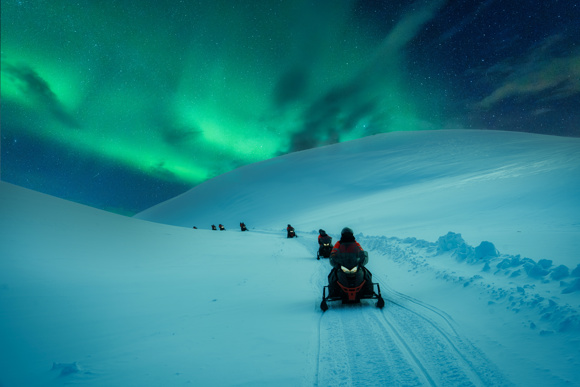
Best time of day to see the Northern Lights in Iceland
The best time of day to see the Northern Lights is in the evening, generally between 11PM and 1AM. Exact times vary, so it’s always worth checking the Icelandic Met Office’s Aurora forecast, which shows cloud cover and auroral activity.
Best place to see the Northern Lights in Iceland
As a general rule, locations that are away from bright city lights give you the best chance of spotting the Aurora Borealis – the less light pollution, the darker the skies and the greater your chances of a light show.
Elevated, wide-open spaces like Thingvellir National Park are a good option for Northern Lights viewing, and remote areas like Westfjords – the country’s most westerly region – combine longer hours of darkness with minimal light pollution, so you can see the aurora against a backdrop of fjords, glaciers and waterfalls.
What factors impact you seeing the Northern Lights?
Solar activity: the more charged particles released from the sun, the higher your chances of seeing the Northern Lights.
Weather: heavy rain and strong wind can impact your view of the sky, and therefore the Aurora Borealis.
Cloud cover: the clearer the skies, the better your chances of viewing.
Light pollution: remote areas where less light is reflected into the sky will offer better chances than big, brightly-lit cities.
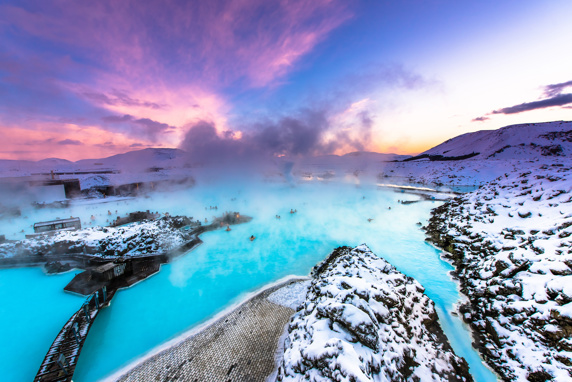
Don’t forget about taking spending money for other activities in Iceland
One of Iceland’s top attractions is the Blue Lagoon, a geothermal spa near Reykjavik that draws quite a crowd all year round. It’s so popular that pre-booking is a must, as slots sell out in advance. Entry prices are dynamic, so they change according to the day and time you choose, but starting prices are listed from £72 – around 11,269kr*. You might find the cheapest slots first thing in the morning and last thing at night, which is also when you’re likely to find smaller crowds – and when you can try to catch the Northern Lights.
While card payments are accepted at the Blue Lagoon and many other big attractions in Iceland, bear in mind that smaller hot springs in more rural areas may only accept cash – so it’s worth carrying some Icelandic krona. The same applies to some public toilets – card payments will be accepted in big cities like Reykjavík, but you may need some coins if you’re heading off the beaten track.
Buying Icelandic Krona with Marks and Spencer Travel Money
Ready to go to Iceland? Buy Icelandic krona online to Click & Collect within minutes from 580+ participating M&S stores**.
*All prices are illustrative and based on average prices at the time of writing in February 2026.
**T&Cs apply. In selected stores, subject to availability.
Share with your friends


