-
Get a £5 M&S voucher with your currency when you collect in a bureau. Find out how.

What is the currency in Hungary?
Hungary’s official currency is the Hungarian forint, which you’ll see written as the symbol Ft and shortened to the currency code HUF. So if you’re planning a trip to this Central European destination – whether it’s a city break to Budapest or a relaxing escape to Lake Balaton – you may find it handy to buy Hungarian forints before you set off, so you’ve got foreign currency ready to spend when you arrive.
But how much spending money do you need to take to Hungary on average, and what’s the current exchange rate for GBP to HUF? We’ve answered these questions and more in our Hungarian currency guide – so you can spend less time planning and more time enjoying your trip.

What you need to know about the Hungarian forint
The Hungarian forint (HUF) is Hungary’s legal tender. It was introduced in 1946 and it’s issued and regulated by the Hungarian National Bank. While Hungary is a member of the European Union, there’s currently no planned date for Hungary to adopt the euro – so this is the currency you’ll need to use if you’re visiting.
Hungarian currency comes as both coins and banknotes.
Hungarian forint denominations
Coins include:
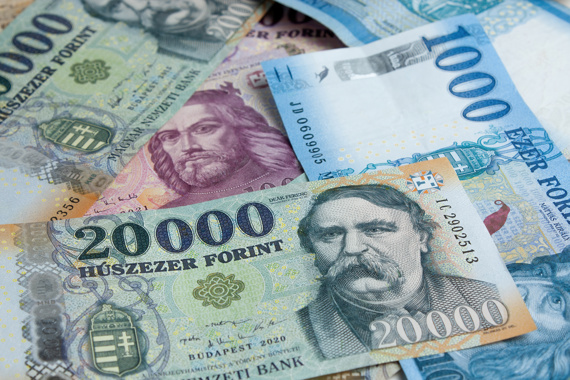
5Ft, 10Ft, 20Ft, 50Ft, 100Ft , 200Ft
Banknotes include:
500Ft, 1,000Ft, 2,000Ft, 5,000Ft, 10,000Ft, 20,000Ft
Is the Hungarian forint used anywhere else in the world?
No – the Hungarian forint is only used in Hungary, so you can’t use it as legal tender in any other countries. If you’ve got leftover forints after a trip to Hungary, you can sell currency back at an M&S Travel Money bureau*.
What is the current exchange rate for the Hungarian forint?
Exchange rates fluctuate all the time, so today’s GBP to HUF rate is likely to be different to tomorrow’s. You can use our currency calculator to get today’s GBP to HUF exchange rate.
What currencies can you use in Hungary?
The Hungarian forint is Hungary’s only official currency, so this is the only currency in regular use here. If you’re making a card payment in Hungary, you might be asked whether you’d like to pay in another currency – like British pounds or euros. It’s usually a good idea to stick to paying in Hungarian forints to avoid additional fees, and we’ve explained why in our guide to paying in the local currency or pounds when abroad.
What payment methods are accepted in Hungary?
Hungary is all set up to accept a range of payment types – from cash to card and digital payment methods. We’ve taken a closer look at your options in Hungary below.
Cash
Cash is still a popular way to pay in Hungary – and while electronic payment methods are becoming more popular in urban areas, it can be particularly useful to have Hungarian forints to hand in rural locations where card payments aren’t always accepted. Cash is also handy when paying for small items at Hungary’s many markets and food kiosks, and for tipping when you’ve received good service. As a general rule, it’s polite to tip around 10% of the bill in restaurants in Hungary, and to round up the fare in taxis.
Debit and credit cards
Debit and credit cards are another popular payment method in Hungary – especially in big cities like Budapest – and Visa and Mastercard are widely accepted. American Express is less widely accepted here, so it’s worth carrying alternative cards as a back-up. Whichever type of card you use to make payments with, bear in mind that there might be additional charges added by your bank. Always check with your card issuer before you travel, and consider using cash to avoid these extra charges.
Digital wallets
Both Apple Pay and Google Pay are available in Hungary, and you’ll find both are widely accepted in cities like Budapest and Eger, and popular tourist destinations like Lake Balaton. If you’re visiting smaller, lesser-known locations, you may find digital wallet payments aren’t supported – so it’s best not to rely on these as your only payment option. In Hungary, like everywhere else in the world, it’s wise to travel with a range of payment options – including some cash for emergencies. Read our guide to travelling with cash for lots of helpful info on the topic.

How much money should I take with me to Hungary?
The amount of spending money you’ll need for a holiday to Hungary depends on lots of things, from the duration of your trip to your plans when you get there. The destination you’re heading to will affect average prices, too, as costs in rural areas may be lower than those in big cities like Budapest, for example.
At the time of writing, the cost of living in Hungary is around 27.7% lower than it is in the United Kingdom, so you’re likely to find prices are comparatively lower while you’re there. To give you an idea, we’ve listed some example costs in Hungary vs the UK below* – just bear in mind these prices are illustrative.
A mid-range three-course meal for two: £65.00 in the UK vs £39.85 (18,000.00 Ft) in Hungary
A small domestic draught beer: £5.00 in the UK vs £1.91 (800.00 Ft) in Hungary
A regular cappuccino: £3.54 in the UK vs £2.02 (847.24 Ft) in Hungary
A one-way ticket on local transport: £2.50 in the UK vs £1.07 (450.00 Ft) in Hungary
*Example prices from Numbeo.com correct as at May 2026. All prices are illustrative.
Buying Hungarian forints with Marks & Spencer Travel Money
Excited to head to Hungary? Don’t forget to take some local currency in cash to use alongside card payments. You can buy Hungarian forints online to collect for free from 580+ participating M&S stores*.
*T&Cs apply. Subject to availability. Sell-back only available at bureau locations.
Share with your friends


